A Gentlemans Guide to Vice and Virtue Review
| Kind Hearts and Coronets | |
|---|---|
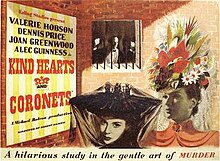 Original British film poster by James Fitton | |
| Directed by | Robert Hamer |
| Screenplay by |
|
| Based on | Israel Rank: The Autobiography of a Criminal by Roy Horniman |
| Produced past |
|
| Starring |
|
| Cinematography | Douglas Slocombe |
| Edited past | Peter Tanner |
| Music by | Ernest Irving |
| Production | Ealing Studios |
| Distributed past | General Moving-picture show Distributors (U.k.) |
| Release engagement |
|
| Running time | 106 minutes |
| Country | United Kingdom |
| Linguistic communication | English language |
Kind Hearts and Coronets is a 1949 British blackness comedy flick. It features Dennis Price, Joan Greenwood, Valerie Hobson and Alec Guinness; Guinness plays 9 characters.[ane] The plot is loosely based on the novel Israel Rank: The Autobiography of a Criminal (1907) by Roy Horniman. It concerns Louis D'Ascoyne Mazzini, the son of a adult female disowned by her aristocratic family for marrying out of her social class. Later on her death, Louis decides to accept revenge on the family and take the dukedom by murdering the eight people ahead of him in the line of succession to the title.
Michael Balcon, the head of Ealing Studios and the producer of Kind Hearts and Coronets, appointed Robert Hamer every bit director. Hamer was interested in the film and thought it an interesting project with possibilities of using the English language in a unique way in the film. Filming took place from September 1948 at Leeds Castle and other locations in Kent, and at Ealing Studios. The themes of form and sexual repression run through the flick, particularly love between classes.
Kind Hearts and Coronets was released on 13 June 1949 in the Britain, and was well received by the critics. It has continued to receive favourable reviews over the years and, in 1999, it was number six in the British Pic Found's rating of the Acme 100 British films. In 2005, it was included in Time 's list of the top 100 films since 1923.
Plot [edit]
In Edwardian England, Louis D'Ascoyne Mazzini, tenth Knuckles of Chalfont, is in prison, awaiting his hanging for murder the following forenoon. As he writes his memoirs, the events of his life are shown in flashback.
His mother, the youngest daughter of the 7th Duke of Chalfont, eloped with an Italian opera singer named Mazzini and was disowned past her family unit for marrying beneath her station. The Mazzinis were poor but happy until Mazzini died presently after Louis, his son, had been born. In the aftermath, Louis's widowed mother raises him on the history of her family and tells him how, unlike other aloof titles, the dukedom of Chalfont can descend through female heirs. Louis's only childhood friends are Sibella and her brother, the children of a local md.
When Louis leaves school, his mother writes to her kinsman Lord Ascoyne D'Ascoyne, a private broker, for assistance in launching her son'south career, but is rebuffed. Louis is forced to work as an assistant in a draper'southward shop. When his mother dies, her last request, to be interred in the family unit vault at Chalfont Castle, is denied. So Sibella ridicules Louis's marriage proposal. Instead, she marries Lionel Holland, a former schoolmate with a rich begetter. Soon later, Louis quarrels with customer Ascoyne D'Ascoyne, the broker'south just kid, who has him dismissed from his job.
Louis resolves to kill Ascoyne D'Ascoyne and the other 7 people alee of him in succession to the dukedom. Subsequently arranging a fatal boating accident for Ascoyne D'Ascoyne and his mistress, Louis writes a letter of the alphabet of condolence to his victim's father, Lord Ascoyne D'Ascoyne, who employs him as a clerk. Upon his later promotion, Louis takes a bachelor flat in St James's, London, for assignations with Sibella.
Louis and so targets Henry D'Ascoyne, a keen amateur lensman. He meets Henry and is overjoyed by his wife, Edith. He substitutes petrol for paraffin in the lamp of Henry's darkroom, with fatal results. Louis decides the widow is fit to be his duchess. The Reverend Lord Henry D'Ascoyne is the next victim. Posing every bit the Anglican Bishop of Matabeleland, Louis poisons his after-dinner port. From the window of his apartment, Louis so uses a bow and arrow to shoot down the balloon from which the suffragette Lady Agatha D'Ascoyne is dropping leaflets over London. Louis next sends Full general Lord Rufus D'Ascoyne a jar of caviar which contains a bomb. Admiral Lord Horatio D'Ascoyne presents a challenge, as he rarely sets foot on land. Still, he conveniently insists on going downwardly with his ship after causing a collision at sea.
When Edith agrees to marry Louis, they notify Ethelred, the childless, widowed 8th duke. He invites them to spend a few days at Chalfont Castle. When Ethelred casually informs Louis that he intends to remarry in order to produce an heir, Louis arranges a hunting "accident". Before murdering the duke, he reveals his motive. Lord Ascoyne D'Ascoyne dies from the stupor of learning that he has become the ninth duke, sparing Louis from having to murder his kindly employer. Louis inherits the championship, simply his triumph proves brusque-lived.
A Scotland Yard detective arrests him on suspicion of having murdered Lionel, who was found dead post-obit Louis'southward rejection of his drunken plea for help to avoid bankruptcy. Louis elects to be tried by his peers in the House of Lords. During the trial, Louis and Edith are married. Sibella falsely testifies that Lionel was about to seek a divorce and name Louis as co-respondent. Ironically, Louis is bedevilled for a murder he had never even contemplated.
Louis is visited by Sibella, who observes that the discovery of Lionel's suicide note and Edith's decease would free Louis and enable them to marry, a proposal to which he agrees. Moments before his hanging, the discovery of the annotation saves him. Louis finds both Edith and Sibella waiting for him outside the prison. When a reporter tells him that Tit-Bits magazine wishes to publish his memoirs, Louis all of a sudden remembers that he has left the incriminating certificate behind in his cell.
Cast [edit]
Product [edit]
Pre-production [edit]

In 1947 Michael Pertwee, a scriptwriter at Ealing Studios, suggested an adaptation of a 1907 Roy Horniman novel, Israel Rank: The Autobiography of a Criminal.[ii] The author Simon Heffer observes that the plot of the source novel was night in places—it includes the murder of a child—and differed in several respects from the resulting film. A major difference was that the main graphic symbol was the half-Jewish (as opposed to half-Italian) Israel Rank, and Heffer writes that Mazzini'southward "ruthless using of people (notably women) and his greedy pursuit of position all seem to conform to the stereotype that the anti-semite has of the Jew".[3]
The change from Israel Rank to Louis Mazzini was brought about by the "post-state of war sensitivity about anti-Semitism", and the moral stance of the films produced past Ealing.[4] According to the British Film Constitute (BFI), the novel is "self-consciously in the tradition" of Oscar Wilde, which is reflected in the snobbery and dandyism portrayed in the film.[v]
The head of Ealing Studios, Michael Balcon, was initially unconvinced by the thought of the film, stating that "I'm not going to brand a comedy virtually eight murders"; the studio's artistic staff persuaded him to reconsider.[half-dozen] Balcon, who produced the film, chose Robert Hamer as director and warned him that "You are trying to sell that most unsaleable commodity to the British – irony. Good luck to you lot."[7] Hamer disliked Pertwee, who withdrew from the project, leaving the scriptwriting to Hamer and John Dighton.[8] Hamer saw the potential of the story and later wrote:
What were the possibilities which thus presented themselves? Firstly, in that of making a pic not noticeably similar to any previously made in the English language. Secondly, that of using this English ... in a more than varied and, to me, more than interesting mode than I had previously had the chance of doing in a flick. Thirdly, that of making a flick which paid no regard whatever to established, although non practised, moral convention.[9]
The film was produced at the same fourth dimension as two other Ealing comedies, Passport to Pimlico and Whisky Galore!; all three were released into UK cinemas over two months.[10] [north 1] The picture show's title was taken from the 1842 poem "Lady Clara Vere de Vere" by Alfred, Lord Tennyson. The full couplet reads
Kind hearts are more than coronets,
And elementary faith than Norman claret.[12]
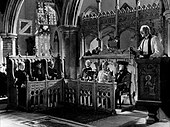
Alec Guinness was originally offered just iv D'Ascoyne parts, recollecting "I read [the screenplay] on a beach in French republic, collapsed with laughter on the first folio, and didn't even bother to go to the end of the script. I went direct back to the hotel and sent a telegram saying, 'Why four parts? Why non viii!?'";[13] he eventually played nine.[i]
Filming [edit]
Product began on 1 September 1948.[fourteen] Exterior filming was undertaken in the Kent villages of Harrietsham and Boughton Monchelsea. Leeds Castle, besides in Kent, was used for Chalfont, the family unit home of the D'Ascoynes.[15] [16] Additional filming was undertaken at Ealing Studios.[14] [n 2]
The costumes were designed by Anthony Mendleson, who matched Louis's ascension through the social ranks with his changing costumes. When employed equally a store assistant, Louis'due south accommodate was ill-fitting and drab; he is afterwards seen in tailored suits with satin lapels, wearing a brocade dressing gown and waiting for his execution in a quilted-collar velvet jacket. Mendleson later recounted that to dress Guinness in his many roles, the costumes were of less importance than make-up and the thespian's nuances.[17]
In 1 shot Guinness appears as six of his characters at in one case in a unmarried frame. This was accomplished past masking the lens. The film was re-exposed several times with Guinness in different positions over several days. Douglas Slocombe, the cinematographer in charge of the effect, recalled sleeping in the studio to make certain nobody touched the camera.[18]
The death of Admiral Horatio D'Ascoyne was inspired past the collision between HMS Victoria and HMS Camperdown off Tripoli in 1893 because of an guild given by Vice-Admiral Sir George Tryon. Victoria was sunk with the loss of over 350 men.[19]
While filming the scene Hamer asked Guinness if he could hold his pose—a salute, facing the camera while the water rose around him—so that the water went over his head; Hamer wanted to testify the admiral's cap floating on the surface. Guinness agreed, telling Hamer that every bit he practised yoga, he could hold his breath for iv minutes. Guinness was fastened to the deck by wires to keep him steady and the shot was taken; when Hamer called "cutting", the crew began packing up and forgot to release Guinness until four minutes afterwards the scene concluded.[20]
Themes [edit]

Leeds Castle, which served as the ancestral dwelling house of the D'Ascoyne family.
The British Flick Institute run across Kind Hearts and Coronets equally "less sentimental" than many of the other Ealing films. Along with The Man in the White Accommodate (1951) and The Ladykillers (1955), Kind Hearts and Coronets "unleash[es] transgressive nightmares, fables of destructive, maverick masculine obsession and action, where the repressed and vengeful bubble up to the surface and lead to a resolutions which were only only contained in the moral strictures permissible in (Balcon'due south) Ealing movie theatre at the time".[21]
The film historian Sarah Street identifies the theme of sexual repression running through the movie, shown with Louis' relationship with the manipulative Sibella.[22] The historian Ross McKibbin sees the motion-picture show as a "sustained satire" in its portrayal of the upper classes, partly because of the intended absurdity of the D'Ascoyne family existence portrayed by Guinness.[23] "Lady Clara Vere de Vere", the poem from which the film'southward title derived, concerns class tensions surrounding honey between classes.[24]
Release and reception [edit]
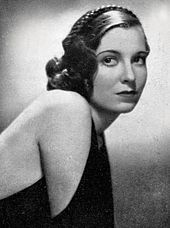
Kind Hearts and Coronets premiered in London on 13 June 1949.[25] When the film was released in the Us the following year, information technology was edited to satisfy the Hays Office Production Code. A new ending was added, showing Louis'due south memoirs existence discovered before he can recall them; the dialogue between Louis and Sibella was altered to play downwards their adultery; derogatory lines aimed at the Reverend Henry D'Ascoyne were deleted; and in the nursery rhyme "Eeny, meeny, miny, moe", "sailor" replaced the word "nigger". The American version is six minutes shorter than the British original.[26]
Kind Hearts and Coronets received a warm reception from the critics.[27] Although they thought the film slightly too long, the critic for The Manchester Guardian thought that overall it was very enjoyable "because of the low-cal satirical touch with which mass-murder is handled, ... words are and so seldom treated with whatever respect in the movie house".[28] Bosley Crowther, the critic for The New York Times, called the film a "delicious little satire on Edwardian manners and morals",[29] while the unnamed reviewer for Fourth dimension called it "one of the all-time films of the year".[27]
Guinness'southward nine roles were praised by several reviewers, including C. A. Lejeune of The Observer.[30] The unknown reviewer from The Monthly Moving picture Bulletin wrote that Guinness played his roles "with intelligence and restraint and show[ed] his power as a character player",[31] while Crowther considered that Guinness acted with "such devastating wit and variety that he naturally dominates the film".[29] Toll's performance was appreciated past a number of critics, including The Monthly Motion picture Message, who considered he gave a "bright performance",[31] and Richard 50. Coe, the critic for The Washington Post thought Price was "splendid";[32] Crowther wrote that Price was "as able every bit Mr. Guinness in his single but well-nigh demanding role".[29] Lejeune in The Observer dissented, and thought he "seems pitifully outclassed every fourth dimension he comes upwards against a Guinness" grapheme.[30]
Kind Hearts and Coronets was nominated for the British Academy Pic Honour for Best British Flick, alongside Passport to Pimlico and Whisky Galore!, although they lost to The Third Man (1949).[33] The picture show was screened as 1 of U.k.'southward entries to the 10th Venice International Film Festival; William Kellner won an award for Best Product Design.[34]
According to Michael Newton, writing for the BFI, Kind Hearts and Coronets has retained the high regard of film historians. In 1964 The Spectator called it "the near confident comedy ever to come out of a British studio",[35] and the actor Peter Ustinov considered it the "well-nigh perfect achievement" of Ealing Studios, "a picture of exquisite construction and literary quality".[36] Kind Hearts and Coronets is listed in Time 'southward top 100 and also at number vi in the BFI Summit 100 British films.[37] [38]
Adaptations [edit]
The film has been adjusted for radio three times. In March 1965, the BBC Home Service broadcast an adaptation by Gilbert Travers-Thomas, with Dennis Price reprising his role equally Louis D'Ascoyne Mazzini.[39] BBC Radio 4 produced a new accommodation in 1980 featuring Robert Powell as the unabridged D'Ascoyne association, including Louis, and Timothy Bateson as the hangman,[40] and another in 1996 featuring Michael Kitchen as Mazzini and Harry Enfield as the D'Ascoyne family.[41]
In May 2012, BBC Radio 4 circulate a sequel to the motion-picture show called Kind Hearts and Coronets – Like Father, Similar Daughter, written by David Spicer. In it, Unity The netherlands, the illegitimate girl of Louis and Sibella, is written out of the title by Edith Duchess of Chalfont. Unity then murders the unabridged D'Ascoyne family unit, with all seven members played by Alistair McGowan.[42]
In September 2004, it was announced that a musical adaption was to be workshopped featuring Raul Esparza, Rebecca Luker, Nancy Anderson and Sean Allan Krill. The workshop had music and lyrics by Steven Lutvak with the book and lyrics by Robert 50. Freedman.[43] The musical was produced under the title A Gentleman's Guide to Beloved and Murder and opened in 2013 at the Walter Kerr Theatre on Broadway. The show has all the victims played by the same player, in the original visitor Jefferson Mays. Though the plot remains essentially the same, most of the names are unlike: half-Italian Louis Mazzini becomes half-Castilian Montague "Monty" Navarro, the D'Ascoynes become the D'Ysquiths and Henry's wife Edith becomes Henry'southward sister Phoebe.[44] [45] The musical won four Tony Awards, including Best Musical.[46]
Digital restoration [edit]
The Criterion Collection released a two-DVD disc gear up. Disc one featured the standard version of the picture released in the UK and, as a bonus feature, includes the final scene with the American ending. Disc two includes a 75-minutes BBC Omnibus documentary "Made in Ealing", plus a 68-minute talk-show appearance with Guinness on the BBC's Parkinson television plan.[47] The British distributor Optimum Releasing released a digitally restored version for both DVD and Blu-ray in September 2011.[48]
To mark the film's 70th anniversary in June 2019, a new 4k restoration scanned from the 35 mm nitrate original negative was released past Studiocanal in Uk cinemas, along with DVD and Blu-Ray versions.[49]
Meet also [edit]
- BFI Tiptop 100 British films
Notes [edit]
- ^ Brian McFarlane, writing for the Oxford Dictionary of National Biography, states that although it was not an aim of releasing the three films together, together they "established the brand proper noun of 'Ealing one-act'".[eleven]
- ^ Although at that place were reports that office of the film was shot at Pinewood Studios, Balcon wrote to Sight and Sound magazine to land that, with the exception of the location filming, it was shot at Ealing.[14]
References [edit]
- ^ a b Fahy, Patrick (21 August 2015). "Alec Guinness: ten essential performances". British Film Institute. Retrieved 13 Feb 2017.
- ^ Sellers 2015, pp. 152–153.
- ^ Heffer, Simon. "Israel Rank Reviewed". Faber and Faber. Archived from the original on 1 September 2012. Retrieved 25 Feb 2017.
- ^ Newton 2003, p. 35.
- ^ Duguid et al. 2012, p. 131.
- ^ Mackillop & Sinyard 2003, p. 75.
- ^ Perry 1981, p. 121.
- ^ Sellers 2015, p. 153.
- ^ Newton 2003, p. 7.
- ^ Barr 1977, p. 80.
- ^ McFarlane, Brian. "Ealing Studios (human activity. 1907–1959)". Oxford Lexicon of National Biography (online ed.). Oxford University Printing. doi:10.1093/ref:odnb/93789. (Subscription or UK public library membership required.)
- ^ Perry 1981, p. 118.
- ^ Hernandez, Raoul (24 February 2006). "Kind Hearts and Coronets". The Austin Relate . Retrieved 7 May 2017.
- ^ a b c Perry 1981, p. 123.
- ^ "Kind Hearts and Coronets (1949)". Kent Film Function. Retrieved 3 March 2017.
- ^ Sellers 2015, p. 195.
- ^ Duguid et al. 2012, pp. 119–121.
- ^ Ellis 2012, p. 15.
- ^ Jasper Copping (12 January 2012). "Explorers raise hope of Nelson 'treasure trove' on Victorian shipwreck". The Daily Telegraph . Retrieved 14 May 2012.
- ^ Sellers 2015, pp. 187–188.
- ^ Duguid et al. 2012, p. 137.
- ^ Street 1997, pp. 68–69.
- ^ McKibbin 1998, p. 455.
- ^ Newton 2003, p. 36.
- ^ Newton 2003, p. 26.
- ^ Slide 1998, pp. 90–91.
- ^ a b Sellers 2015, p. 158.
- ^ "New Films in London". The Manchester Guardian. 25 June 1949. p. 5.
- ^ a b c Crowther, Bosley (15 June 1950). "Alec Guinness Plays viii Roles in 'Kind Hearts and Coronets,' at Trans-Lux 60th Street at the Cinemet". The New York Times . Retrieved 23 February 2013.
- ^ a b Lejeune, C. A. (26 June 1949). "An Acadian Summer". The Observer. p. 6.
- ^ a b "Kind Hearts and Coronets (1949)". The Monthly Pic Message. xvi (181–192): 118.
- ^ Coe, Richard L. (xiv July 1950). "One Fashion to Gain A Ducal Coronet". The Washington Post. p. B4.
- ^ "Film: British Film in 1950". British Film Institute. Retrieved v Oct 2016.
- ^ "Awards At Venice Moving picture Festival: Two British Winners". The Manchester Guardian. 3 September 1949. p. eight.
- ^ Newton 2003, p. 25.
- ^ Perry 1981, p. 8.
- ^ "All-Fourth dimension 100 Movies". Time. 3 October 2011. Retrieved 14 March 2017.
- ^ "The BFI 100: 1–10". British Film Institute. Archived from the original on 29 January 2012. Retrieved 14 March 2017.
- ^ "Saturday-Night Theatre: Kind Hearts and Coronets". BBC Genome Project. BBC. Retrieved half-dozen May 2017.
- ^ "Kind Hearts and Coronets". BBC Genome. BBC. Retrieved half dozen May 2017.
- ^ "Sat Playhouse: Kind Hearts and Coronets". BBC Genome. BBC. Retrieved half dozen May 2017.
- ^ "Saturday Drama: Kind Hearts and Coronets – Like Father, Like Daughter". BBC. Retrieved 20 May 2012.
- ^ Gans, Andrew (29 September 2004). "Esparza and Luker to Take Part in Workshop of Kind Hearts and Coronets Musical". Playbill . Retrieved five September 2019.
- ^ Stasio, Marilyn (17 Nov 2013). "Broadway Review: A Gentleman's Guide to Love and Murder". Diversity . Retrieved 14 March 2017.
- ^ Rooney, David (17 November 2013). "A Gentleman'due south Guide to Dear and Murder". The Hollywood Reporter . Retrieved 14 March 2017.
- ^ "A Gentlemans Guide to Love and Murder". Tony Awards. Retrieved xiv March 2017.
- ^ "Kind Hearts and Coronets". The Criterion Collection. Retrieved 14 March 2017.
- ^ "Kind Hearts and Coronets". My Reviewer. 29 June 2011. Retrieved fourteen March 2017.
- ^ "Kind Hearts and Coronets". Studiocanal. 4 June 2019. Retrieved nine June 2019.
Sources [edit]
- Barr, Charles (1977). Ealing Studios . Newton Abbot, Devon: David & Charles Publishers. ISBN978-0-7153-7420-seven.
- Duguid, Mark; Freeman, Lee; Johnston, Keith Grand.; Williams, Melanie (2012). Ealing Revisited. London: Palgrave Macmillan. ISBN978-one-84457-510-seven.
- Ellis, David A. (2012). Conversations with Cinematographers. Lanham, MD: Scarecrow Press. ISBN978-0-8108-8126-6.
- Mackillop, Ian; Sinyard, Neil, eds. (2003). British Cinema of the 1950s: A Celebration. Manchester: Manchester University Printing. ISBN978-0-7190-6489-0. Archived from the original on 25 February 2017. Retrieved 24 February 2017.
- McKibbin, Ross (1998). Classes and Cultures: England 1918–1951. Oxford: Oxford Academy Press. ISBN978-0-xix-820672-9. Archived from the original on 28 February 2017. Retrieved 27 Feb 2017.
- Newton, Michael (2003). Kind Hearts and Coronets. London: British Picture Constitute. ISBN978-0-85170-964-two.
- Perry, George (1981). Forever Ealing. London: Pavilion Books. ISBN978-0-907516-60-half dozen.
- Sellers, Robert (2015). The Secret Life of Ealing Studios. London: Aurum Press. ISBN978-one-78131-397-8.
- Slide, Anthony (1998). Banned in the U.S.A.: British Films in the Usa and Their Censorship, 1933–1966. London: I.B.Tauris. ISBN978-i-86064-254-eight.
- Street, Sarah (1997). British National Movie theatre. London: Routledge. ISBN978-0-415-06735-5. Archived from the original on 28 February 2017. Retrieved 27 February 2017.
External links [edit]
- Kind Hearts and Coronets at AllMovie
- Kind Hearts and Coronets at the British Movie Institute
- Kind Hearts and Coronets at IMDb
- Kind Hearts and Coronets at the BFI's Screenonline
- Kind Hearts and Coronets: Ealing's Shadow Side an essay past Philip Kemp at the Criterion Collection
Source: https://en.wikipedia.org/wiki/Kind_Hearts_and_Coronets
0 Response to "A Gentlemans Guide to Vice and Virtue Review"
Post a Comment